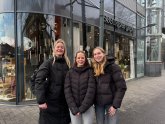
Under the overall theme of "EUREGIOnally sustainable", the project days of the introductory phase take place annually as a cross-border educational project over three days. 60 pupils from the Werner-von-Siemens Gymnasium work together with students from the Dutch partner school Het Stedelijk Lyceum Enschede on key issues for the future of the Euregio. The aim is to look at sustainability in the European border region from different perspectives and to develop practical, creative and future-oriented ideas together.
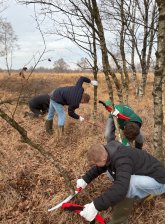
In mixed German-Dutch groups, the participants deal with ecological, social and cultural aspects of sustainability, among other things. These include projects on EUREGIOnal communication and cooperation (see "EUREGIONAL COMMUNICATION"), regional and sustainable nutrition (see "EUREGIONAL SUSTAINABLE COOKING COURSES"),on the sustainable use of water resources (see "WATER EUREGIONAL"), intergenerational exchange (see "EUREGIONAL ENCOUNTERTAINMENT"), and the importance and protection of natural and moorland landscapes (see "HÜNDFELDER MOOR").
Another component of the project days is practical work, such as excursions, surveys or small research assignments on site. The results are creatively prepared, presented and reflected on in a European context. In this way, the project days not only promote knowledge about sustainability, but also intercultural skills, teamwork and European cooperation.
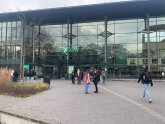
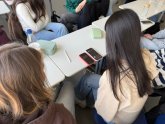
On February 10, pupils from the Werner-von-Siemens-Gymnasium visited Saxion University of Applied Sciences. The aim of the visit was to find out more about the EUREGIO and the cooperation between Germany and the Netherlands. Even outside the modern building, it was clear how international the university is. A presentation gave the participants an insight into topics such as sustainable transportation and the regional economy. The idea of how an app could better connect people in the region was particularly exciting. The students then continued to work in small groups and conducted interviews. They discussed the advantages of the EUREGIO and possible ideas for the future. Many found the group work interesting because it allowed for an open exchange. Some reported that they were able to broaden their horizons as a result of the visit. All in all, it was an instructive and varied day.
Layout 1
Day 1
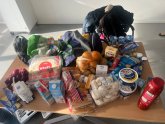
The course began with a search for recipes. The participants set off to buy regional products. The places to go were Lidl and K+K, K+K being a regional store in Westmünsterland. This shopping trip ensured that the ingredients were fresh and local, which not only increased the quality of the food, but also supported the local economy.
Day 2
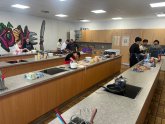
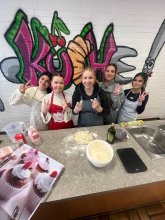
The recipes were then prepared on the second day. The groups worked with great enthusiasm on their culinary creations. Every step of the preparation process was carefully documented to record how the regional food was handled. The participants not only learned the individual steps of preparation, but also a lot about the origin of the ingredients and their importance for sustainability. At the end of the day, the lovingly prepared dishes were ready to be eaten, and the joy of cooking together and the appreciation for regional cuisine were clearly noticeable.
Layout 1
As part of the project days, we dealt intensively with the topic of water in the EUREGIO. The aim of these project days was to get to know the process of a supervised project and to deal with different forms of work relating to the topic of water. The focus was not on the end result, but on the joint working process.
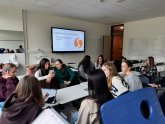
At the beginning, we attended a presentation by Tom Voortmann. In his presentation, he introduced the topic of water and presented various aspects and issues that are important for the EUREGIO. The presentation served as a basis for the content and provided impetus for the subsequent group work and our own discussion of the topic.
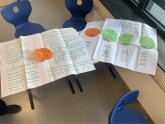
We then continued working in small groups. Our task was to create our own presentations on the topic of water. We used the GPRW as a central basis for this. First, we discussed in the groups how we wanted to structure our presentations and what we wanted to focus on. The tasks were distributed within the groups so that each person could contribute to the joint work. During the work phases, we collected information, structured content and regularly exchanged information about the status of our work. The teachers supported the group work without dictating the work process.
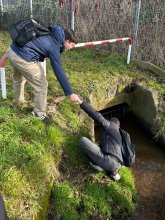
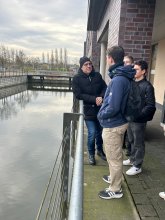
On the second day of the project, our work shifted from the classroom to the outdoors. The aim was not just to look at the topic of water in theory, but to investigate and experience it directly on site in Gronau. Together with our teacher Mr. Adamsky, we made our way through the town. We stopped at various stations to find out more about the respective places and their significance for water in the region. Mr. Adamsky and Max explained the special features of the individual locations and provided additional information on the development and use of the water bodies.
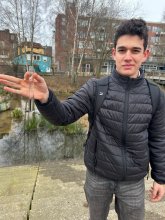
Our first stop was the water tower, where we learned more about the water supply and the historical significance of the building. We then went to the point where the Dinkel rejoins and learned how the course of the river changes and what effects this has on the surrounding area. In the city park, we accompanied the Dinkel, observed the banks and collected water samples and garbage from the water. This allowed us to become active ourselves and make a contribution to environmental protection. After a short break, we continued our walk through the city center to the lagoon area and the northern part of the city. Finally, we treated ourselves to an ice cream together before returning to school.
The project days offered us the opportunity to consciously perceive water in our immediate surroundings, to better understand ecological relationships and to gain practical experience. Through the presentations, group work and observations on site, we were able to get to know the entire process of a project - from the introduction to the planning to the practical implementation - and deepen our knowledge of water in the EUREGIO.
Layout 1
As part of the Werner-von-Siemens-Gymnasium's project days, the pupils of the "EUREGIOnale Begegnung" group have taken on a task - they want to bring the different generations closer together across the border. "We want to give older Dutch people in retirement homes the opportunity to spend time with younger German pupils in order to promote exchange on several levels within the EUREGIO between young and old," is how seventeen-year-old pupil Leni S. describes her project.
The school projects took place over three days, during which the pupils worked intensively on the topic of the EUREGIO. On the first day, Monday, the pupils in this group began to gather initial ideas and formulate more detailed plans. Milou Vaartjes from EUREGIO Youth visited the group to explain the basic idea of the EUREGIO to the pupils. She first explained a few details about her role and assured the pupils of her support.
The accompanying teacher Fabian Busch said in an interview that he was very excited to see what the students would come up with, but was confident and expected really good results. Nevertheless, he had no specific expectations and was open to the students' ideas.
From the young people's initial deliberations, it emerged that the group wanted to spend a morning in a retirement home in the Netherlands. Games and communicative activities were planned for this visit. To make this happen, the students called a number of retirement homes using the Dutch they had learned at school. Unfortunately, the sixteen- to seventeen-year-old students did not receive any concrete confirmations due to the short notice. Nevertheless, most of the institutions seemed to be very interested in general and did not want to rule out future collaborations of this kind.
In view of the increasing number of rejections, the apprentices decided to send three of them to present the idea to the retirement homes in person. Unfortunately, this was also unsuccessful for the reasons mentioned above.
On the morning of Tuesday, the events of the previous day were first discussed and alternative plans were considered. In the end, everyone agreed to prepare an advertising flyer for future groups that would like to implement this project and to draft an email to make it easier to ask retirement homes for this type of activity in the future. These were successfully created in a subsequent work phase. In addition, a kind of "image film" is to be produced to illustrate the course of a visit by the group of pupils.
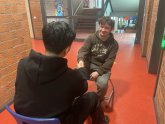
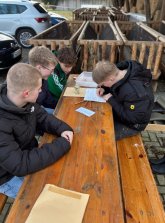
But the young people didn't just want to prepare and plan - they also wanted to take action. They therefore decided to travel to Enschede on the same day to carry out generation-related surveys. The response to the survey was largely positive. Many of the respondents, both Dutch and German, were very open-minded and pleased with the students' initiative.
The results of the interviews were compiled and evaluated on the last day, Wednesday, and then presented clearly for the following step-by-step museum tour for all groups.
Layout 1
In the first stage of their work, they dealt with the topic of moors. They found out what moors are and how they are formed. They also worked out what different types of moors there are.
In a further step, they investigated which factors damage a moor and which conditions are important for the preservation and development of a moor. They also studied the typical animal species that live in moors and learned about their special adaptations to this habitat.
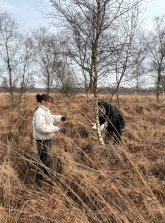
In addition, they visited the Hündfelder Moor with the group. During this excursion into the moorland, they also analyzed the soil and the trees that grow there. And used the knowledge they had previously acquired.